

The AI Bubble?
The greatest bet in business history, or the greatest bubble ever inflated? A market-first look at the question underneath the hype: is the price being paid for AI right now justified

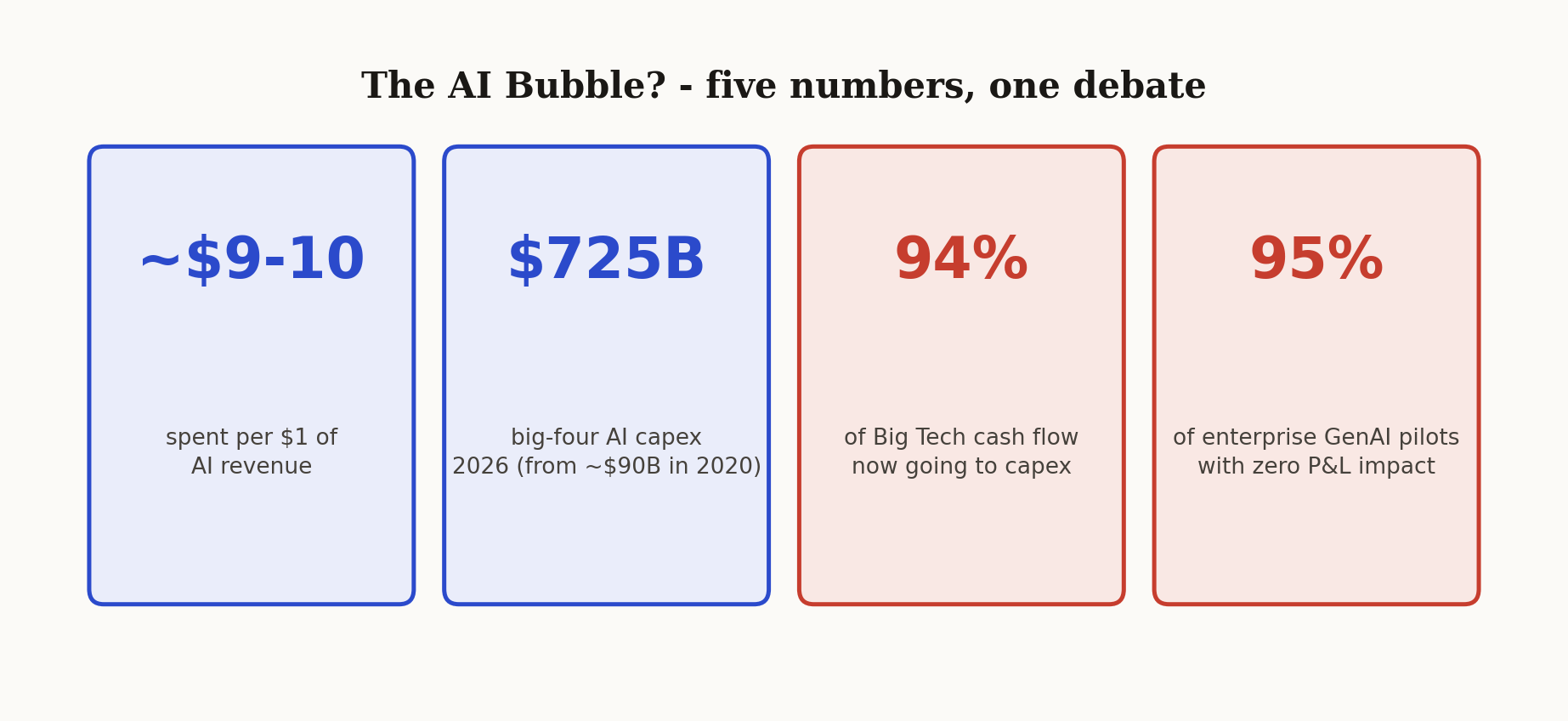
Nobody serious disputes that AI is real and useful. The market question is narrower and colder: does the price make sense? For every $1 the AI industry earns today, its biggest players are spending roughly $9–10 building the capacity to deliver it. This piece argues both sides and lands on a probability, not a verdict.
Five very different numbers get quoted in this debate, and they blur together constantly:
$725B — 2026 AI capex from the big four hyperscalers alone (Microsoft, Google, Amazon, Meta).
~$1.5T — estimated total AI infrastructure spend across the whole industry in 2026.
~$3T — Sequoia’s David Cahn’s estimate of the annual revenue AI must eventually earn to justify that build-out.
~$50–100B — roughly what the largest AI firms actually earn today: OpenAI ~$25B run-rate, Anthropic ~$30–47B ARR, plus Google/Microsoft AI revenue.
The gap — the distance between the last two is the entire debate. It is the widest it has ever been, and widening.
Part 1 · How AI actually “thinks”
Strip away the mystique and a large language model — the technology behind ChatGPT, Claude and Gemini — does one deceptively simple thing: it predicts the next most-likely word (technically, a “token”), over and over, one at a time. It does not look up answers, and it has no store of facts it “knows.” It has learned, from an enormous amount of text, a statistical sense of what word tends to follow what. Everything else — the fluency, the reasoning, the occasional confident nonsense — falls out of that single mechanism.
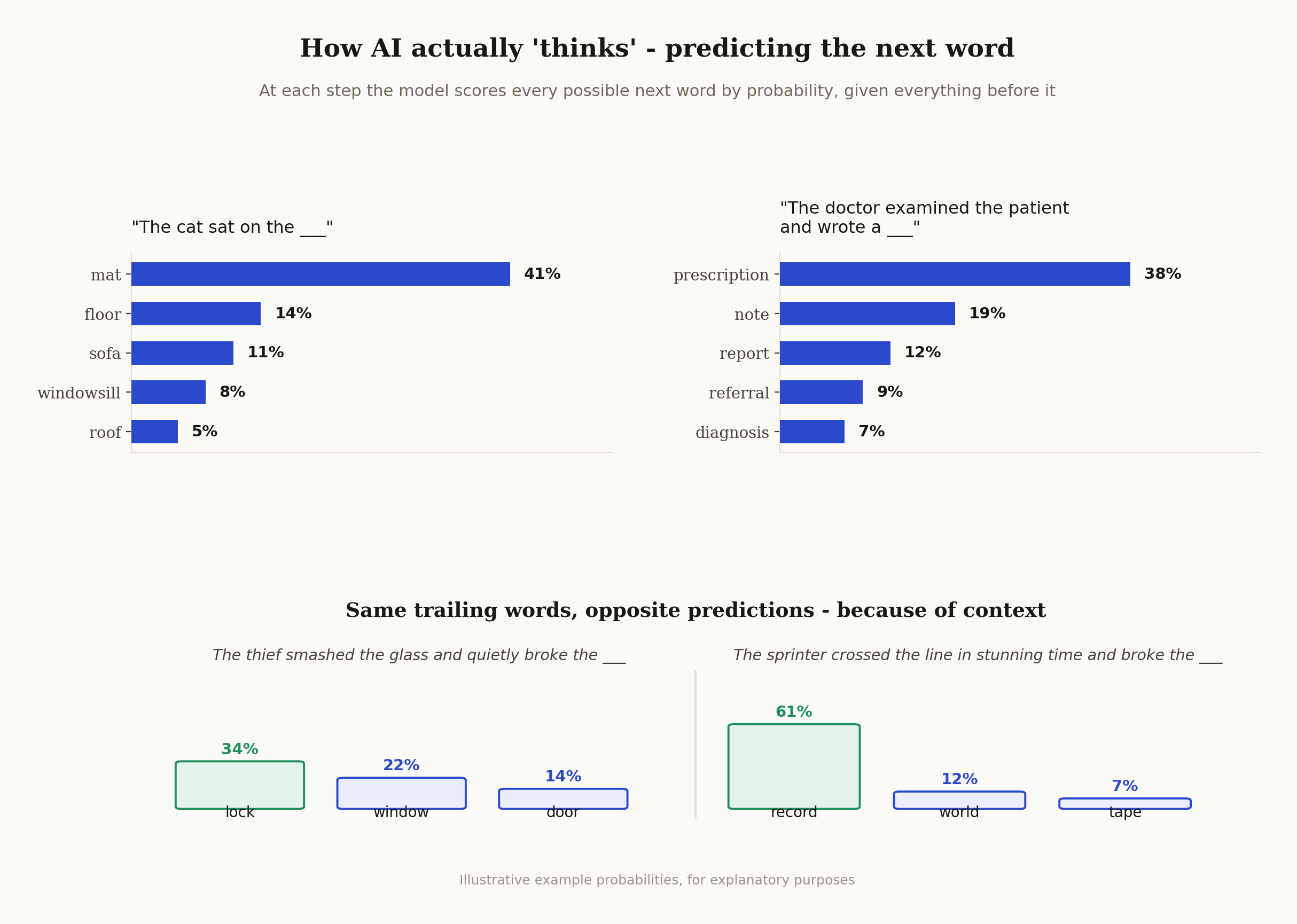
Here is what that looks like in practice. At each step, the model produces a probability for every possible next word and usually picks a likely one.
Given "The cat sat on the," it assigns roughly 41% to "mat," 14% to "floor," 11% to "sofa."
Given "The doctor examined the patient and wrote a," it assigns 38% to "prescription," 19% to "note," 12% to "report."
Change the words that come before, and the whole distribution shifts — which is the whole game. Take the same three trailing words, "…broke the," and place them after two different sentences. After "The thief smashed the glass and quietly broke the," the model favors "lock" (34%), "window" (22%), "door" (14%). After "The sprinter crossed the line in stunning time and broke the," it favors "record" (61%), "world" (12%), "tape" (7%). Identical trailing words, opposite predictions — because of context.
The practical lesson: because the model’s entire output is steered by the words in front of it — its “context” — the single biggest lever you have over the quality of an answer is the quality of the context you give it. Thin, vague context produces thin, vague output. This is also why the same model can feel brilliant for one person and useless for another: the difference is often not the model, but what it was told. And it is why “hallucination” is not a bug that can be fully patched out — a model that is always predicting a plausible next word will sometimes predict a plausible-sounding falsehood with total confidence.
That understanding pays off directly in practice. A few techniques reliably improve output, and all of them are really just ways of feeding the model better context:
Give it a role and an audience. “You are a tax lawyer explaining to a founder…” narrows the space of likely next words toward the register you want.
Show, don’t just tell (few-shot). Two or three worked examples pin down the exact format and tone far better than describing them.
Ask it to reason step by step. Making the model lay out intermediate steps before answering measurably improves multi-step logic and math.
Ground it in your own documents (RAG). “Answer only from the text below, and quote the clause” is the single highest-leverage move against hallucination.
State the negatives. “Do not invent citations; if unsure, say so” — models follow explicit boundaries far more reliably than implied ones.
One more distinction cuts through most AI headlines: there are really two AI booms running at once, and they are not the same in maturity or risk.
Predictive AI (classical machine learning) is the quiet, mature kind — statistical models that forecast a number or category. It has run credit scoring, fraud detection and recommendation engines since the 2000s. Well-understood, largely uncontroversial, rarely what a breathless headline is about.
Generative & agentic AI is the young, loud kind — models that write, code, talk and increasingly act. Only three to four years old at enterprise scale, and the source of almost all the current excitement, investment and unresolved risk. When you read “AI” in a 2026 market story, this is almost always what is meant.
Part 2 · From if-then rules to (maybe) AGI
“AI” is not one technology but a sixty-year ladder of them, each rung less brittle and more general than the last. Knowing which rung a claim sits on is the fastest way to tell hype from substance.
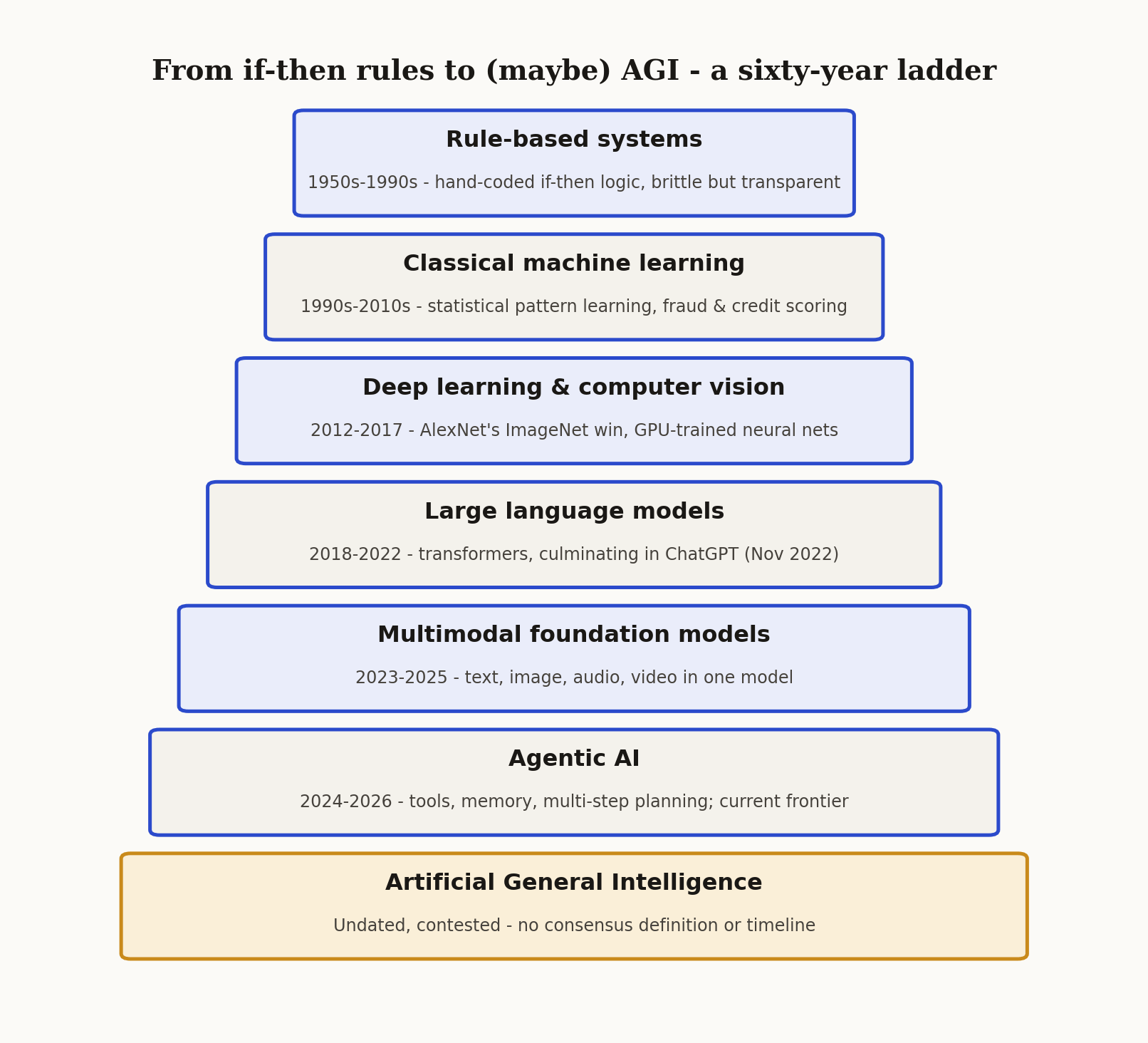
Rule-based systems (1950s–1990s): hand-coded if-then logic. Transparent and predictable, but brittle — it cannot handle anything its authors did not anticipate. No learning from data at all.
Classical machine learning (1990s–2010s): statistical models that learn patterns from structured, labelled data — the workhorse of fraud detection and credit scoring for two decades. Needs hand-engineered features and clean data.
Deep learning & computer vision (2012–2017): many-layered neural networks trained on GPUs over large labelled image sets. AlexNet’s 2012 ImageNet win is the widely cited starting gun. Task-specific — a vision model cannot write an email.
Large language models (2018–2022): transformer architectures trained on internet-scale text, culminating in ChatGPT’s November 2022 launch, which took generative AI from research curiosity to consumer product overnight. Fluent but unreliable.
Multimodal foundation models (2023–2025): single models handling text, images, audio and video together, increasingly used as a general reasoning layer plugged into other software. Compute- and data-hungry; each increment of quality costs more than the last.
Agentic AI (2024–2026): models wired to tools, memory and multi-step planning so they can pursue a goal across many actions with limited supervision — the current frontier of investment and hype. Reliability and accountability for autonomous action remain unresolved.
Artificial General Intelligence (undated, contested): a hypothetical system matching or exceeding human capability across essentially all cognitive tasks. No consensus definition or timeline exists among researchers. Not a measurable engineering milestone today — treat any confident date claim with skepticism.
“Agentic” is the word doing the most work in 2026. Here is what an AI agent actually does — a loop, not a single answer.
Take the goal: “Book a dinner table for four this Friday at 8pm near the office.”
The agent reasons (”I need an available restaurant — first I should search nearby”),
Calls a tool (a search query), observes the result (five options, two with online booking, one fully booked)
Reasons again, calls another tool (a booking API), and observes a failure (the API needs a phone number it doesn’t have).
At that point a good agent stops and asks the human, rather than guessing.
That last step is the crux. A good agent knows when to stop; a bad one confidently books the wrong thing. This is exactly why nearly four in five enterprises have piloted agents, yet only about one in nine run them in production — the gap between a demo and a reliable, unsupervised agent is still wide.
On AGI itself: some frontier-lab leaders — who are also raising capital on the claim — say it’s “a few years away.” Many academic researchers say “decades, or ill-defined.” Sceptics argue it’s “not a coherent milestone” at all, since current models lack genuine understanding. Treat the term as a hype-detector: the more precisely someone dates it, the more sceptical you should be.
Part 3 · Why now — and why so much money
Four forces explain why capital flooded into AI specifically, and why the scale of the bet is so large:
Scaling laws. Research through the 2010s and 2020s repeatedly found that model performance improves smoothly and predictably as compute, data and parameters scale up together. That predictability is what convinced investors that pouring capital into bigger training runs was a rational bet rather than a gamble — the single biggest reason capital flooded in.
Data & transfer learning. The internet had, by the late 2010s, produced enough freely available text, code and images to train models at a scale no single company could have licensed by hand. Training once on that data and cheaply adapting the result to thousands of narrower tasks made a single expensive run reusable across a whole industry.
Cheap capital. Near-zero interest rates through the 2010s, then a flight to the clearest growth story in tech, concentrated enormous capital into AI: AI-related venture funding reached roughly $202.3B in 2025, close to half of all global VC investment.
The ChatGPT distribution moment. None of the underlying tech was new in November 2022 — transformers, scaling laws and web-scale data had existed for years. What changed was packaging: a free, one-box chat interface anyone could use took generative AI from 0 to 100 million users in about two months, the fastest consumer-product adoption on record. The lesson generalises: in AI, distribution and interface can matter as much as the model.
The road here, briefly:
AlexNet wins ImageNet (2012), convincing the field that scale plus deep learning was the way forward.
The Transformer paper (2017) — “Attention Is All You Need” — gives every major LLM since (GPT, Claude, Gemini, Llama) its architecture.
GPT-3 (2020) demonstrates emergent scale effects, supporting the scaling-laws thesis.
ChatGPT launches (Nov 2022), reaching 100 million users in about two months.
GPT-4 and the enterprise pilot wave (2023) — McKinsey estimates generative AI could add $2.6–4.4 trillion annually across 63 use cases, a figure still cited as the baseline.
Open-weight models and the agent pivot (2024–25) — Meta’s Llama and, from early 2025, China’s DeepSeek release highly capable open-weight models at a fraction of prior training cost, undercutting the idea that only a few labs could compete.
The agentic & infrastructure build-out (2025–26) — enterprise focus moves to agents even as most organisations stay stuck in “pilot purgatory”; hyperscaler AI-data-centre capex exceeds $350B in 2025, and data-centre electricity demand becomes a first-order political issue.
Part 4 · The seven layers — and the three choke points
AI is built in layers. Most of the money, and all of the real bottlenecks, sit near the bottom — in chips, power and data. That concentration is a big part of why the spending is so vast and so few companies capture it.
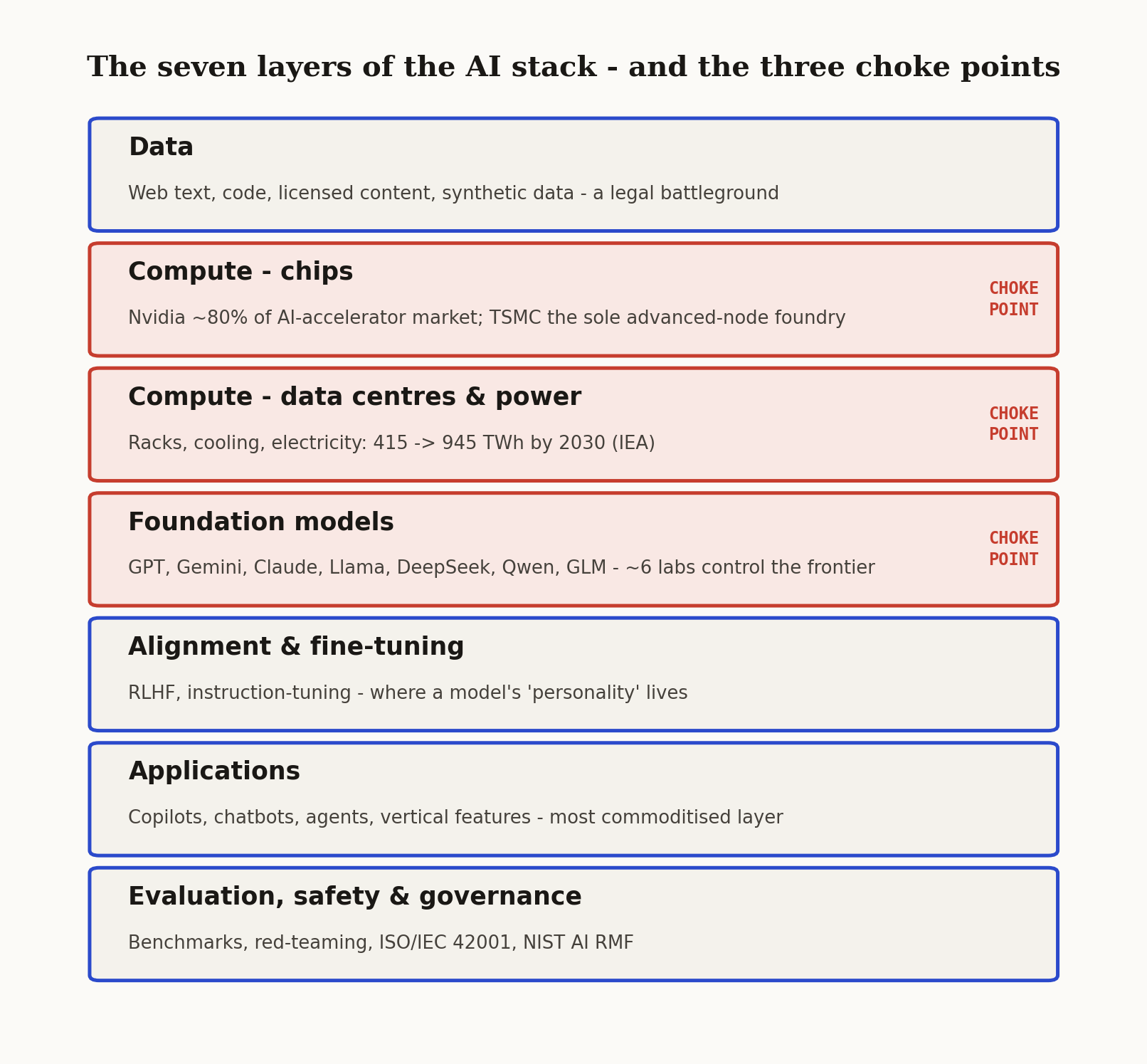
The three genuine choke points:
Advanced AI chips. Nvidia holds roughly 80% of the AI-accelerator market, and TSMC is effectively the sole advanced-node foundry able to fabricate the leading chips — virtually every leading chip, Nvidia’s, AMD’s, and hyperscalers’ custom silicon alike, passes through it. TSMC’s advanced-node capacity and CoWoS packaging are reportedly booked out for years, with Nvidia taking a large share. A single geopolitical or manufacturing disruption in Taiwan would immediately choke the entire industry’s ability to train or serve frontier models. Lesson: sovereign AI ultimately needs sovereign or allied access to advanced chip fabrication — software alone cannot route around this bottleneck.
Electricity & data-centre capacity. The IEA projects data-centre electricity demand roughly doubling from ~415 TWh (2024) to ~945 TWh by 2030, with AI the dominant driver. In some US states and countries (Ireland, Virginia) data centres already draw a fifth or more of total electricity. Power availability, not chip supply, is increasingly the binding constraint on how fast new capacity can be built. AI’s physical footprint — power, water, land — is becoming as strategically important as its digital one, and draws the same local political resistance as any heavy industry.
Frontier model training. Roughly six labs — OpenAI, Google, Anthropic, xAI, DeepSeek, Zhipu — can credibly compete at the very top, because training a genuinely frontier model costs tens to hundreds of millions in compute alone. But this choke point compresses faster than the physical ones: open-weight releases (Llama, DeepSeek, Qwen, GLM) have shown near-frontier capability at a fraction of the presumed cost. Algorithmic efficiency keeps lowering the compute needed to reach yesterday’s frontier.
A fourth layer, high-quality training data, is a contested rather than settled choke point: the freely-scrapeable internet text that trained the first LLMs is finite and non-renewing, and a fast-growing share of new web content is itself AI-generated — raising the risk of models training on their own degraded output (”model collapse”). Licensing disputes and lawsuits are actively reshaping what data can legally be used, pushing labs toward paid licensing, synthetic data and proprietary enterprise data. Data is shifting from an abundant free input to a scarce, litigated, paid-for one — a structural change in the industry’s cost base most forecasts do not yet price in.
Who actually matters worldwide. The frontier is no longer a US monopoly. By mid-2026 the leading models come from three regions, and the open-weight challengers — many Chinese — have compressed the gap to the closed US frontier to a matter of months. On the closed-frontier side:
GPT-5 (OpenAI) remains the consumer default and pace-setter;
Claude (Anthropic) is safety-differentiated with particular strength in coding and agentic work, ~85% of revenue from enterprise and developers, and passed OpenAI on revenue run-rate in 2026;
Gemini 3 (Google DeepMind) has deep research pedigree and distribution through Search, Android and Workspace;
Grok 4 (xAI) has distribution via X. On the open-weight side: Llama (Meta) reset the field by giving away a model free to commoditise the layer;
DeepSeek (China) reset global assumptions in early 2025 by reaching near-frontier quality at a fraction of the presumed training cost;
GLM-5 (Zhipu/Z.ai, China’s first publicly-listed AI lab) has a strong agentic-coding focus;
Qwen (Alibaba) is among the most widely-adopted open-weight families globally;
Kimi (Moonshot AI) competes directly with closed frontier models at markedly lower cost; Mistral/Magistral (France) is Europe’s flagship sovereignty-driven contender.
The pattern: the US leads the closed frontier, China leads open-weight and training efficiency, Europe fields one serious sovereignty-driven contender. The open-weight wave is the single biggest threat to the “only a handful of labs can compete, so token prices can rise forever” assumption that underpins frontier-lab valuations.
Part 5 · The bull case — why this may not be a bubble
The technology genuinely works. Unlike some past manias, the product is real and used daily by hundreds of millions. Generative AI reached an estimated 53% adoption among the general population within about three years — faster than the PC or the internet.
Revenue is growing very fast. The leading labs are scaling revenue at rates rarely seen: Anthropic went from roughly $1B to a ~$30–47B run-rate inside 18 months, and OpenAI reached a ~$25B run-rate. Fast growth can, in principle, close even a very wide gap.
The spenders are the strongest companies in history. Unlike the debt-laden telecom builders of 2000, the biggest AI spenders are among the most profitable firms ever. Nvidia earned roughly $120B in net income last year; Microsoft, Google and Amazon are cash machines. They will not simply collapse if returns are slow.
Valuations are rich, but not insane. The NASDAQ-100’s forward P/E is around 26x today, versus roughly 60x at the 2000 dot-com peak. Expensive, and concentrated in a few names — but not the pure fantasy of the last great tech bubble.
Individuals are extracting real value now. Even where enterprise ROI is unclear, the estimated value of generative-AI tools to US consumers reached about $172B annually by early 2026, with median value per user roughly tripling year over year.
Part 6 · The bear case — why it may be a bubble
This is the single most important chart in the AI market. Sequoia’s David Cahn estimates the revenue AI must earn to justify the infrastructure being built. That required figure has ballooned from a “$200B question” (2023) to a “$600B question” (2024) to an implied multi-trillion figure by 2026 — while actual AI revenue, though growing fast, remains an order of magnitude smaller.
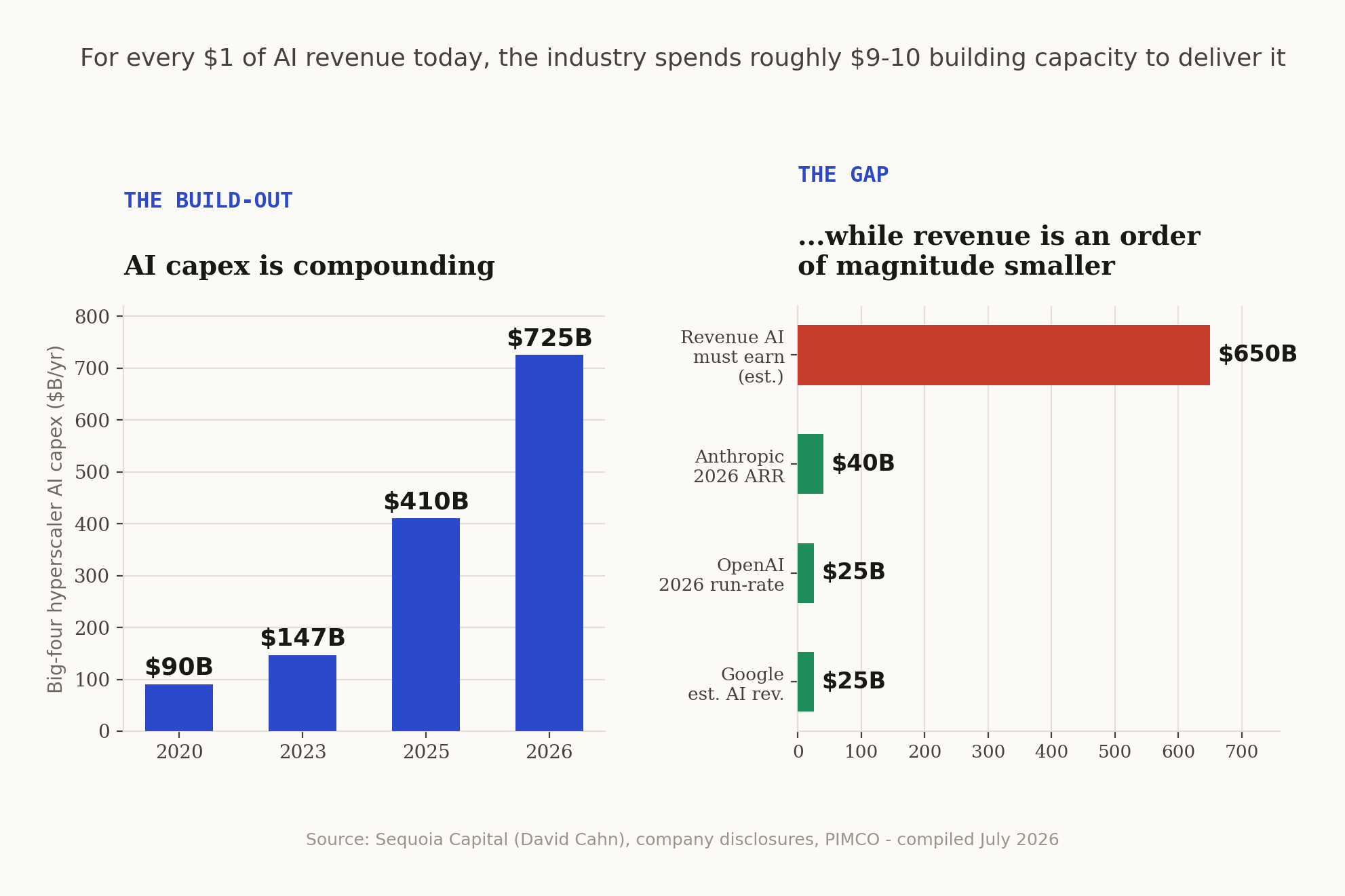
Big-four AI capex has gone from ~$90B (2020) to $147B (2023) to $410B (2025) to $725B (2026). The gap itself has widened from a $200B question (2023) to $600B (2024) to an estimated ~$800B+ annual gap in 2026 — Allianz pegs the capex-vs-revenue divergence at ~46%, exceeding the ~32% seen in the 2001 telecom bubble.
The cash-flow squeeze. PIMCO estimates Big Tech capex will consume ~94% of operating cash flow over the next two years, up from ~40% in 2023 — meaning for every $100 earned, only ~$6 is left for dividends, buybacks, salaries and everything else. For the first time, the hyperscalers are also leaning on debt: the big five raised roughly $108B in new debt in 2025.
Enterprise ROI — the crack in the revenue side. The core bull rebuttal is “enterprises will pay, because AI makes them radically more efficient.” The data from the industry’s own consultants is, so far, harsher. MIT Project NANDA found 95% of enterprise GenAI pilots showed zero measurable P&L impact (2025, 300 deployments). BCG’s “AI at Scale” survey of 1,800 executives found only ~26% of companies are generating meaningful financial value from AI. S&P Global found 42% of companies abandoned most AI projects in 2025 — more than double the prior year. McKinsey’s 2026 State of AI found fewer than 20% of pilots reach enterprise-scale production.
Most failures are not the technology’s fault — MIT found ~70% of the work to make AI pay off is process and workflow redesign, not the model. But from a market standpoint the cause barely matters: if the ROI is not showing up in the P&L, the revenue needed to justify the capex is not showing up either.
The “AI tax” — how a chip war reaches your checkout.
The build-out is no longer confined to Silicon Valley balance sheets — it is now visible at the checkout counter.
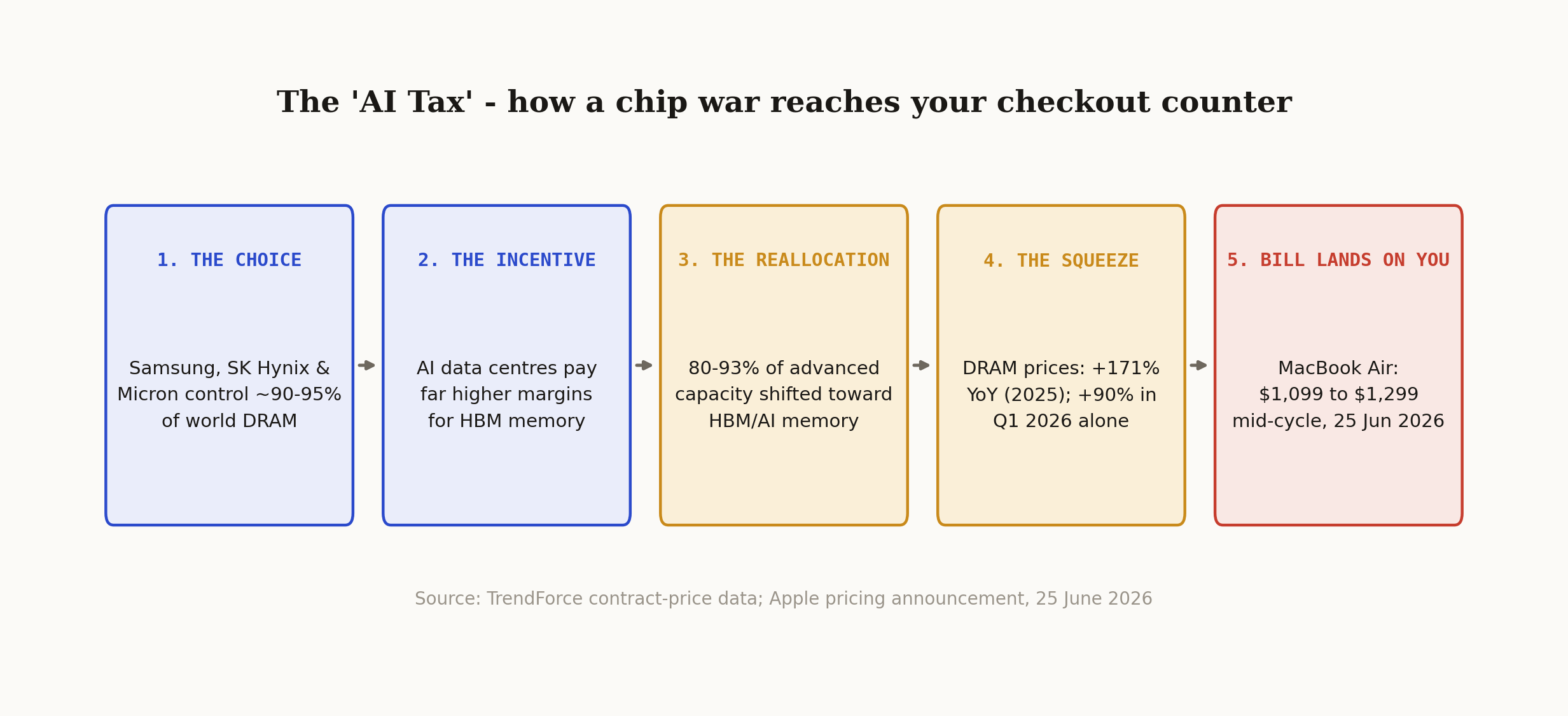
Samsung, SK Hynix and Micron control ~90–95% of the world’s DRAM. They can sell standard memory to Apple, Dell and HP, or the special High-Bandwidth Memory (HBM) that AI data centres need — and AI data centres pay far higher margins per wafer.
Capital flows to the highest bidder, so the big three shifted an estimated 80–93% of advanced production toward HBM and AI-server memory; HBM sold out for 2026. Because HBM and standard DDR5 draw on the same wafer capacity, there is simply less left for phones, laptops and consoles.
Contract DRAM prices rose about 171% year-on-year by late 2025 and roughly 90% in Q1 2026 alone, per TrendForce — a shortage analysts dubbed “RAMageddon.”
On 25 June 2026, Apple did something almost unprecedented: a mid-cycle price hike with no new hardware. The MacBook Air’s starting price rose from $1,099 to $1,299, with iPad and Apple TV also up, explicitly citing memory costs. Relief is not expected before late 2027.
When the richest, most vertically-integrated hardware company on earth raises prices mid-cycle and names memory costs as the reason, the AI build-out has measurably reached ordinary consumers.
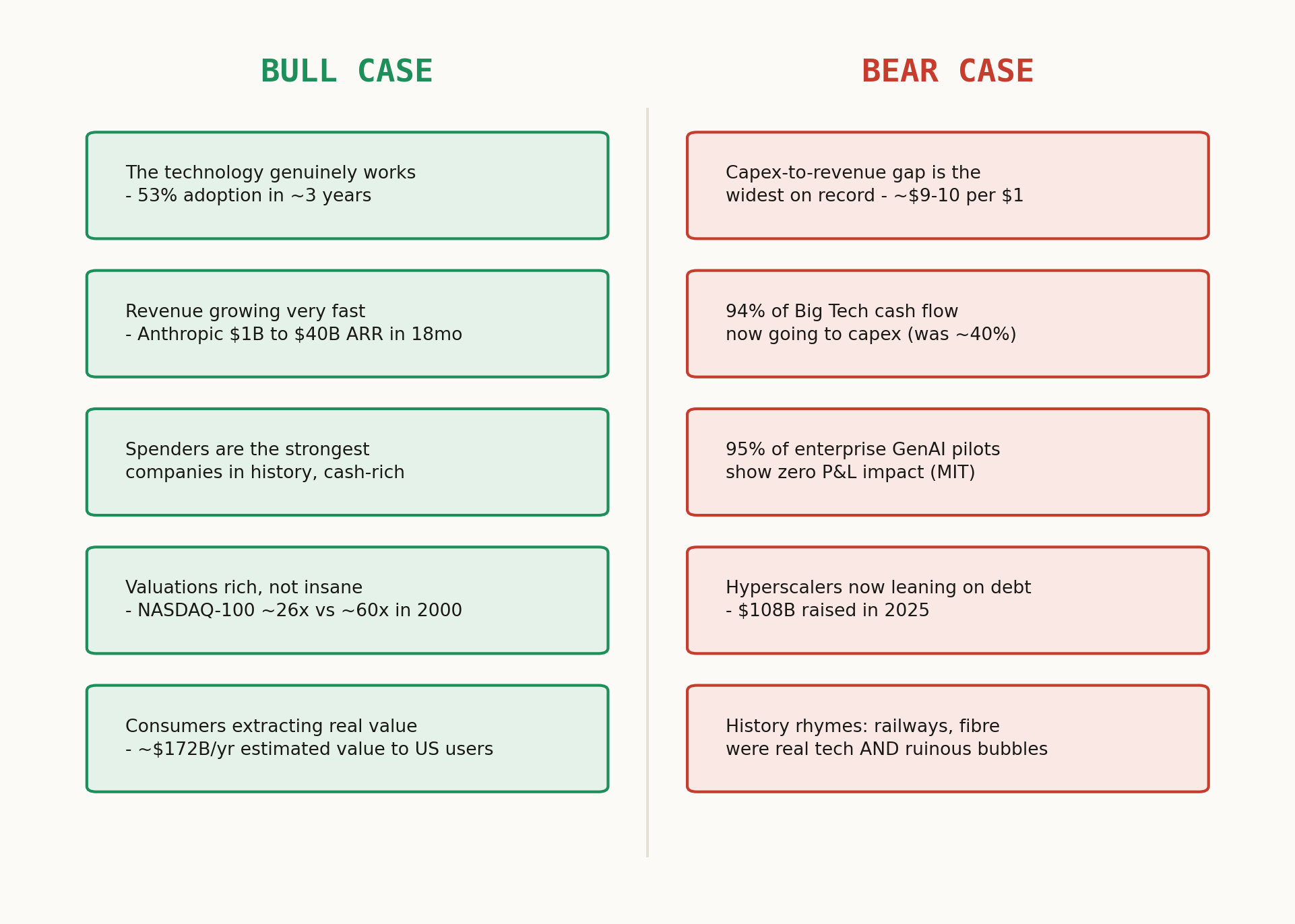
Set side by side, the two cases — bull and bear — look like this:
Part 7 · What history says
The technology can be completely real and the bubble can still burst. That is not a contradiction — it is the normal pattern of every industrial build-out in history. The pattern runs four steps: high returns attract capital; capital keeps flowing until overcapacity is built; overcapacity triggers collapse; survivors inherit the wreckage cheaply and, when demand finally catches up, make fortunes on assets others paid to build.
British Railway Mania (1840s). Parliament authorised ~9,500 miles of track. Roughly one-third was never built; investors were wiped out. But the surviving lines became the backbone of Britain’s rail network. Lesson: real, world-changing infrastructure — and still a devastating bubble.
Telecom / dot-com fibre (1996–2001). ~$500B poured into fibre-optic cable after the 1996 Telecom Act. By the early 2000s as little as ~5% of laid fibre was “lit”; ~$2T of market value was wiped out, stocks down ~95%. That “dark fibre” later became the physical backbone of YouTube, Netflix and AWS. The internet was real and did change everything — the companies that built it mostly died anyway. Demand grew ~100%/yr, not the ~1,000%/yr priced in.
AI data centres (2026–?). ~$725B/yr from the big four alone; ~$1.5T total AI infrastructure implied for 2026. How much of this capacity goes to waste is unknown — that is precisely the open question. Same pattern, mid-flight.
Two things genuinely distinguish this from the telecom bust. First, the spenders: telecom builders were debt-funded and unprofitable, whereas today’s are among the most profitable firms in history and will not simply collapse. Second, valuations are rich but not insane — the NASDAQ-100 forward P/E is ~26x versus ~60x at the 2000 peak. Anyone who tells you this is definitely a bubble is guessing; so is anyone who tells you it definitely is not.
Part 8 · How it ends — three paths from here
If you accept there is meaningful bubble risk, the useful question is what actually happens next. There are broadly three paths — and two of them hurt, in different ways.
The bubble pops (plausible). The market corrects hard, jobs are lost, and Big Tech slams the brakes on spending. Because that spending feeds India’s IT and services sector, the downstream risk lands on outsourced and entry-level tech jobs before the boom’s benefits fully arrive. Hits hyperscalers, chip suppliers, AI startups — and India’s export-led IT/services economy.
No pop — prices rise instead (plausible). To justify their valuations, labs race toward profitability by raising prices. Frontier AI becomes something only the giants can afford, and today’s cheap, subsidised tools become a luxury. Many AI products die not because the tech failed, but because it got too expensive to run. Hits AI-dependent startups and everyday users of currently-subsidised tools.
The miracle (small but real). Token costs collapse through efficiency gains (the DeepSeek-style playbook), enterprises finally realise ROI, and demand catches up to the overbuild. Everyone makes money and the infrastructure was worth it after all. This is the bull-case outcome — genuine, but on current evidence the least probable of the three.
Part 9 · Beyond the bubble — where the value is real
The market question is about price, not usefulness. On usefulness the evidence is clear: in several domains AI already delivers real, measurable value.
Biotech & drug discovery. Predicting protein structures and screening drug candidates — compressing work that once took years of lab time into a computational task. AlphaFold learned the patterns linking amino-acid sequence to 3D shape from every known structure, a problem unsolved for ~50 years; it now predicts a structure in minutes and has released ~200 million of them, nearly every known protein, free to researchers. The work earned a 2024 Nobel Prize in Chemistry. Caveat: predictions still need experimental validation for high-stakes use — AI accelerates discovery, it does not replace the wet lab.
Software engineering. AI coding assistants have driven measurable productivity gains — a controlled study found developers completed a task ~55% faster with an assistant than without. Software is the single largest value pool McKinsey identifies. Caveat: entry-level developer employment (ages 22–25) has reportedly fallen nearly 20% since 2022 (Stanford Digital Economy Lab) — productivity gains and job losses are two sides of the same coin, and it raises a real question about how future senior engineers get trained.
Banking & financial services. Fraud detection, underwriting and customer service. McKinsey estimates generative AI alone could add $200–340B annually to banking, on top of decades of mature predictive-AI use in fraud and credit scoring. Caveat: algorithmic bias in credit and insurance underwriting is one of the most-litigated AI-fairness issues.
Customer operations. One of four functions McKinsey found account for ~75% of generative AI’s economic potential. AI can reduce human-serviced contact volume by up to 50% in banking, telecom and utilities. Caveat: over-automation is a leading driver of customer frustration when escalation paths to a human are unclear.
Healthcare. AI-assisted diagnostics, imaging triage and administrative automation. Caveat: diagnostic errors carry life-or-death stakes, and liability for an AI-assisted misdiagnosis remains legally unsettled in most jurisdictions.
Manufacturing & agriculture. Predictive maintenance, computer-vision quality inspection and precision-input application. Caveat: benefits concentrate among larger, better-capitalised operators, risking a widening gap with smaller players.
The pattern across real deployments: AI delivers when it augments a human who verifies its output, and fails when it is trusted to act unsupervised in an accuracy-critical setting.
Wins: AlphaFold (~200M protein structures, free, 2024 Nobel); GitHub Copilot study (developers ~55% faster, controlled 2022 study); JPMorgan COIN (contract-review automation reportedly saving ~360,000 hours/year); Indian BFSI fraud detection (mature, low-controversy predictive AI at national scale).
Fails: Klarna (replaced ~700 service roles with AI in 2024; by 2025 the CEO admitted it “went too far” and began rehiring); Deloitte Australia (delivered a A$440,000 government report containing fabricated citations from ungrounded AI use; issued a partial refund); Air Canada (a support chatbot invented a refund policy; a tribunal held the airline liable for its bot’s words); Mata v. Avianca (lawyers filed a brief with fake ChatGPT-generated citations and were sanctioned — now the canonical warning, with 1,200+ copycat incidents tracked since).
Part 10 · The legal & safety repricing
AI’s legal and safety exposure is now a first-order market factor, not a footnote. More than 70 AI copyright suits alone had been filed by early 2026, and the outcomes are turning training data from a free input into a licensed, litigated one. Courts are converging on two principles: a “market-harm” test (does the AI output substitute for the market of what it was trained on?) and a bright line on piracy (licensing is defensible, torrenting is not).
Bartz v. Anthropic (settled) — a court ruled training on legally-acquired books is transformative fair use, but storing pirated books was not. Anthropic settled for $1.5B (~$3,000/work) — the largest copyright recovery in US history — and agreed to destroy the pirated dataset.
NYT v. OpenAI & Microsoft (active) — alleges millions of articles were copied to train ChatGPT; seeking “billions.”
Thomson Reuters v. Ross (decided for plaintiff) — the first final US judgment on AI training data: using Westlaw headnotes to train a competing legal-research AI was NOT fair use, precisely because the AI competed with the source’s market.
Getty v. Stability AI (split ruling) — within days in late 2025, a UK court rejected Getty’s core copyright claim while a Munich court found for rights-holders on memorised content — the same technology, opposite verdicts in two legal systems.
Garcia v. Character Technologies (settled, precedent stands) — the first federal ruling that a conversational AI can plausibly owe a duty of care to minor users, bypassing the Section 230 immunity that historically shielded platforms.
The era of “train on everything for free” is legally over. Every frontier lab has pivoted to paid licensing deals (OpenAI–News Corp, AP, Axel Springer; Google–Reddit) as both legal protection and an admission that the old approach was unsustainable — a structural rise in the industry’s cost base most forecasts do not yet price in.
Six safety concerns with real market consequences:
Reliability & hallucination — independent research found error rates of 69–88% on complex, multi-document professional tasks even where vendors cite sub-1% figures on narrow benchmarks; verification is a permanent cost, not a temporary one.
Minor safety & duty of care — wrongful-death suits against AI-companion makers allege engagement-maximising design contributed to teen harm; safety-by-design is becoming a survival requirement.
Data leakage & “shadow AI” — surveys found ~66% of office workers use AI tools against policy, and over a third have pasted customer or confidential financial data into public models.
Concentration & systemic risk — one firm supplies ~80% of AI accelerators, one foundry fabricates nearly all advanced chips, a few labs control frontier training; a single disruption could ripple through the whole AI economy at once.
Energy, water & environment — data-centre electricity demand is projected to roughly double to 945 TWh by 2030, and AI-related water withdrawal could reach several billion cubic metres a year by 2027.
Autonomy & agentic accountability — as agents move from drafting to acting, who is accountable when an autonomous agent errs remains legally unresolved; nearly four in five enterprises have adopted agents in some form, but only about one in nine run them in production.
Part 11 · The India cut
India enters this cycle overwhelmingly as a consumer and adapter of foundation AI, not yet a producer of frontier models — but with a uniquely large, multilingual digital population, a mature Digital Public Infrastructure stack (Aadhaar, UPI, ONDC) and an aggressive, well-funded government push to change that within the decade.
Read every “sovereign AI” or “Made-in-India LLM” claim carefully. As of 2026, India’s most capable homegrown models (Sarvam, Krutrim) are trained substantially on imported Nvidia H100/H200-class chips, often on architectures derived from open Western or Chinese research, and run on subsidised but still foreign-manufactured compute. Genuine sovereignty in AI ultimately requires sovereignty in advanced chip fabrication — a multi-year, capital-intensive undertaking even with the Tata Electronics Dholera fab underway, which targets mature nodes, not the advanced ones AI training needs.
The numbers:
₹10,372 cr (≈$1.25B) IndiaAI Mission outlay, approved March 2024.
38,000+ GPUs subsidised via IndiaAI, targeting 100,000 by end-2026.
$18–37B India AI market size in 2026 (wide spread across analysts).
$3T — AI’s projected add to Asia-Pacific GDP by 2030 (Google.org/ADB estimate).
The policy stack, in order:
the DPDP Act (2023), India’s first comprehensive data-protection law;
the IndiaAI Mission (March 2024), a five-pillar programme of subsidised compute, indigenous foundation models, a national open-datasets platform (AIKosh), an applications fund and AI skilling;
BHASHINI maturing (2025) into 300+ pre-trained models across all 22 scheduled Indian languages plus several tribal languages;
AI Mission 2.0 & Sarvam-105B (2026), a further GPU expansion and India’s most capable sovereign-track open model to date; and
Semicon India / the Tata Dholera fab (2026), ₹91,526 cr targeting mature nodes and 50,000 wafer starts/month — necessary groundwork, but still far from advanced-node AI chips.
Who’s exposed:
TCS/Infosys/HCLTech/Wipro are repositioning as “AI-first” services firms winning AI-transformation and GCC deals — but are the most double-edged beneficiary, since the same AI that wins deals also automates the coding and maintenance work that built them (India hosts 2,117 GCCs generating $98.4B and employing 2.36M people).
Sarvam AI (Bengaluru) is the first startup selected under the IndiaAI Mission, released open-source Sarvam-30B and 105B, raised a $53M Series A — though it still runs on imported chips, and thin Indic-language training data is flagged as a deeper constraint than compute.
Krutrim (Ola, Bhavish Aggarwal-led) has Indian-language models with a committed ₹10,000 cr investment and an Nvidia supercomputer partnership.
Fractal Analytics (Mumbai unicorn) predates the generative wave by two decades, serving Fortune 500 clients.
Uniphore/Yellow.ai/Observe.AI apply AI to contact-centre automation with real revenue rather than frontier-model bets.
Netradyne does computer-vision driver-safety and fleet monitoring.
Haptik (Reliance Jio) runs conversational AI inside India’s largest consumer digital ecosystem.
The most investible India-AI story is arguably not the models but the physical build-out beneath them — data-centre capacity, power, cooling, connectivity and the electrical suppliers that enable it, a value chain with visible order books rather than speculative model revenue. The discipline is the same as anywhere: check what a company actually sells, how much revenue is genuinely AI-linked, and whether the demand is already in orders and earnings versus only in the narrative.
Six things worth knowing before you believe the headlines
“AI redundancy washing” is now a named phenomenon. Analysts warned that 2026 would see companies blaming AI for layoffs actually driven by other cost pressures — and a separate finding that 55% of leaders who cut jobs citing AI later privately called it the wrong move. Even Amazon, cutting ~16,000 corporate roles in January 2026, said AI was not the main driver of most cuts.
ROI case studies are cherry-picked. An IBM survey of 2,000 CEOs found only 1 in 4 AI projects delivers the ROI it promised, and just 16% are scaled enterprise-wide — yet public vendor and customer case studies overwhelmingly showcase the successful minority.
Most employees route around official AI policy. A 2026 survey of 1,250 office professionals found 66% had used AI at work despite believing it wasn’t permitted, and 88% had shared work information with public AI tools.
The loudest forecasters are walking their own predictions back. Having warned in 2025 that AI could eliminate half of entry-level white-collar jobs, both OpenAI’s and Anthropic’s CEOs softened that framing by mid-2026 — the loudest forecasts often come from people with a direct financial stake in them being believed.
“Agentic” is doing marketing work. Nearly four in five enterprises have adopted AI agents in some form, yet only about one in nine run them in production — the gap between an agent demo and a reliable production agent remains wide, whatever a pitch deck implies.
Benchmark numbers are only as good as the task. Vendor sheets cite sub-1% hallucination on narrow, favourable tests; independent research on real-world complex tasks has found 69–88% error rates. Always ask what task a benchmark number was measured on.
The verdict — so, is it a bubble?
Five signals to watch going forward: whether the capex-to-revenue gap is finally narrowing or still widening (the master gauge); whether enterprise ROI starts showing up in the P&L rather than just adoption stats; whether token prices are falling (efficiency winning) or rising (labs forcing profitability); whether debt levels at the hyperscalers stay contained (cash-funded overbuild is survivable; debt-funded is how bubbles turn systemic); and whether the open-weight frontier (DeepSeek, GLM, Qwen) keeps closing the gap, which would break the “prices can rise forever” thesis.
The honest answer is a probability, not a verdict. The technology is real and useful; the revenue is growing fast; the spenders are strong. And yet the capex-to-revenue gap is the widest on record, enterprise ROI is mostly not showing up, some of the spend is now debt-funded, and history’s comparable build-outs — railways, fibre — were real, world-changing, and still ruinous bubbles. On the balance of evidence: a high probability of a bubble in the price being paid right now, not a certainty — and, crucially, that is fully compatible with AI changing the world anyway.
We are not betting on whether AI matters. We are betting on whether today’s price for it makes sense.
In their own words
“AI’s $200B question is now AI’s $600B question.” — David Cahn, Partner, Sequoia Capital, on the widening gap between AI infrastructure spend and the revenue needed to justify it.
“Because you’re out of imagination.” — Jensen Huang, CEO, Nvidia, arguing that using AI merely to cut headcount, rather than to grow output, reflects a failure of ambition.
“Irresponsibly oversold.” — Alex Karp, CEO, Palantir, on enterprises paying for AI tokens that, he says, create no real business value — striking given Palantir is itself an enterprise-software winner.
“Hitting the labor market like a tsunami.” — Kristalina Georgieva, Managing Director, IMF, warning at Davos that most countries and businesses are unprepared for AI’s speed of labour-market impact.
“The AI bubble looks bigger than the 1990s tech bubble.” — Torsten Slok, Chief Economist, Apollo, on his analysis that the largest US tech names are more richly valued relative to fundamentals than at the dot-com peak.
“Pretty wrong.” — Sam Altman, CEO, OpenAI, reassessing his own 2025 warning that generative AI would rapidly eliminate entry-level white-collar roles.
“We went too far.” — Sebastian Siemiatkowski, CEO, Klarna, on the company’s push to replace customer-service staff with AI before reversing course and rehiring.
Sources
Sequoia Capital (David Cahn), AI’s $600B Question, 2024–26
MIT Project NANDA, The GenAI Divide: State of AI in Business, 2025
Goldman Sachs Global Institute, Tracking Trillions: The AI Build-Out, 2026
Boston Consulting Group, AI at Scale (1,800 executives), 2026
TrendForce, DRAM / HBM Contract Price Outlook, 2026
Stanford HAI, The 2026 AI Index Report
McKinsey & Company, The Economic Potential of Generative AI, 2023–25
International Energy Agency, Energy and AI, 2025
World Economic Forum, Future of Jobs Report 2025
MeitY / PIB (Government of India), IndiaAI Mission — status update, 2026
This explainer describes a way of thinking, not a recommendation to buy, sell, use or avoid any product, vendor or security.